



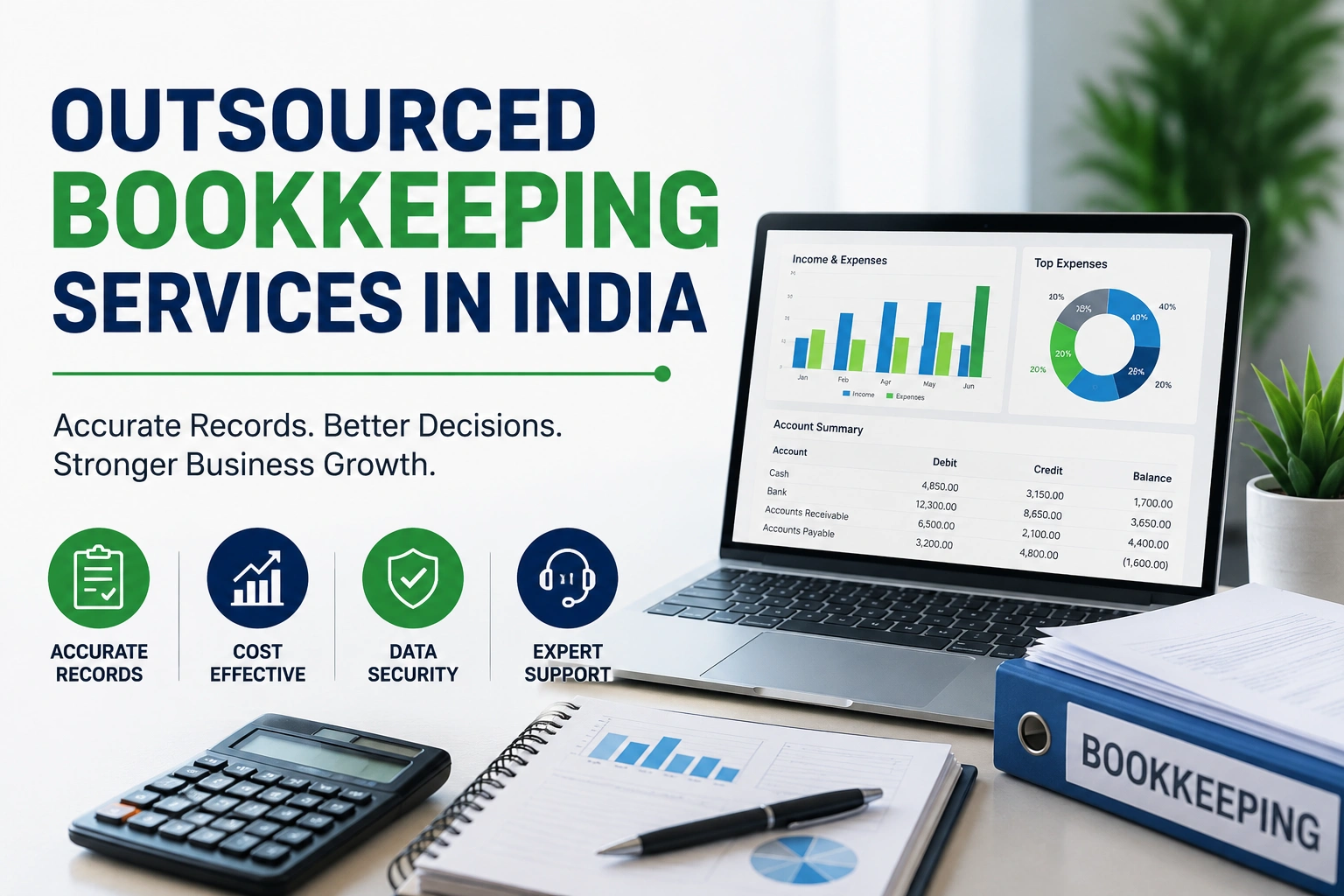
Managing accurate financial records is essential for every business, but maintaining bookkeeping internally can become time-consuming and expensive as a company grows. This is why many startups, small businesses, agencies, e-commerce companies, and professional service providers are choosing outsourced bookkeeping services.
By outsourcing bookkeeping, businesses can delegate routine financial record-keeping to experienced professionals while focusing more on customers, operations, sales, and growth.
For businesses looking for reliable outsource bookkeeping services in India, outsourcing can provide access to accounting expertise, technology, and structured financial processes without the cost of building a large in-house accounting team.
What Are Outsourced Bookkeeping Services?
Outsourced bookkeeping services involve hiring an external accounting or bookkeeping service provider to manage a company’s financial record-keeping activities.
Instead of employing a full-time internal bookkeeping team, a business works with an external provider that handles tasks such as:
- Recording sales and purchases
- Recording business expenses
- Bank reconciliation
- Accounts payable
- Accounts receivable
- Invoice management
- Transaction categorization
- General ledger maintenance
- Financial reports
- GST-related bookkeeping support
- Payroll-related accounting records
- Month-end bookkeeping
The exact services depend on the business’s requirements and the agreement with the bookkeeping provider.
Why Do Businesses Outsource Bookkeeping?
Bookkeeping involves repetitive financial tasks that require accuracy and consistency. As transaction volumes increase, managing these tasks internally can take significant time.
Businesses commonly outsource bookkeeping to:
- Save administrative time
- Reduce bookkeeping workload
- Improve financial record accuracy
- Access experienced bookkeeping professionals
- Reduce the cost of maintaining an internal team
- Keep financial records updated
- Improve cash-flow visibility
- Support tax and GST compliance
- Obtain regular financial reports
Outsourcing allows business owners to focus on running and growing their businesses while financial records are maintained by dedicated professionals.
What Is Included in Outsourced Bookkeeping Services?
A professional bookkeeping provider can offer a wide range of services depending on the company’s needs.
1. Daily Transaction Recording
Bookkeepers record financial transactions such as:
- Sales
- Purchases
- Expenses
- Payments
- Receipts
- Bank transactions
- Credit transactions
Accurate transaction recording creates the foundation for reliable financial reporting.
2. Bank Reconciliation
Bank reconciliation compares the transactions recorded in accounting records with the company’s bank statements.
This helps identify:
- Missing transactions
- Duplicate transactions
- Incorrect entries
- Bank charges
- Unrecorded payments
- Unreconciled deposits
Regular reconciliation helps ensure that accounting records reflect the actual financial position of the business.
3. Accounts Receivable
Accounts receivable bookkeeping tracks money that customers owe to the business.
This may include:
- Recording customer invoices
- Tracking outstanding balances
- Monitoring overdue invoices
- Recording customer payments
- Reconciling customer accounts
Better receivables management can help businesses improve cash flow.
4. Accounts Payable
Accounts payable bookkeeping tracks amounts owed to suppliers and vendors.
A bookkeeping provider can help businesses:
- Record supplier invoices
- Track payment due dates
- Record vendor payments
- Reconcile supplier accounts
- Monitor outstanding liabilities
5. Invoice Management
Professional bookkeeping services can help businesses maintain organized sales invoices and payment records.
Proper invoice management makes it easier to track revenue and outstanding customer payments.
6. Expense Management
Businesses have numerous operating expenses, including:
- Office expenses
- Software subscriptions
- Advertising
- Travel
- Rent
- Utilities
- Professional fees
- Employee expenses
- Business supplies
Outsourced bookkeepers can categorize and record these expenses according to the appropriate accounting structure.
7. GST Bookkeeping Support
For businesses registered under GST in India, maintaining accurate transaction records is an important part of financial management.
Bookkeeping support may include:
- Recording GST-related transactions
- Sales reconciliation
- Purchase reconciliation
- Tracking eligible input tax credit records
- Reviewing invoice information
- Preparing accounting data for GST compliance
The specific compliance work depends on the business and the services agreed upon with the accounting professional.
8. Month-End Bookkeeping
Month-end bookkeeping involves reviewing and updating financial records regularly.
This can include:
- Bank reconciliation
- Expense review
- Accounts receivable review
- Accounts payable review
- Transaction verification
- Ledger review
- Financial report preparation
Regular month-end processes help businesses maintain up-to-date financial information.
Benefits of Outsourcing Bookkeeping
1. Reduce Operating Costs
Maintaining an internal bookkeeping team involves salaries, employee benefits, software, training, equipment, and other administrative costs.
Outsourcing can provide a more flexible alternative depending on the business’s transaction volume and requirements.
2. Save Time
Business owners and internal employees don’t have to spend hours entering transactions, reconciling accounts, and preparing routine reports.
3. Access Professional Expertise
Outsourced bookkeeping providers work with financial records regularly and can establish standardized bookkeeping processes.
4. Improve Financial Accuracy
A structured bookkeeping process can reduce errors caused by inconsistent data entry, missing transactions, and delayed reconciliation.
5. Better Cash Flow Visibility
Updated books help business owners understand:
- Current cash position
- Outstanding customer payments
- Upcoming supplier payments
- Monthly expenses
- Revenue trends
6. Easier Tax Preparation
Well-maintained financial records can make it easier to prepare information needed for applicable tax and GST compliance.
7. Scalable Support
A business can adjust bookkeeping support as transaction volumes and operational requirements change.
Outsource Bookkeeping Services in India
India has become a popular location for outsourced bookkeeping because businesses can access a large pool of accounting professionals and technology-enabled financial services.
Outsource bookkeeping services in India can be suitable for both Indian businesses and companies operating internationally.
Indian bookkeeping providers may support businesses with:
- Bookkeeping
- Accounting data entry
- Bank reconciliation
- Accounts payable
- Accounts receivable
- Financial reporting
- GST bookkeeping
- Payroll accounting support
- Month-end closing
For international businesses, the provider’s familiarity with the relevant accounting standards, software, reporting requirements, and time-zone expectations should be considered before outsourcing.
Who Can Benefit From Outsourced Bookkeeping?
Small Businesses
Small businesses often need professional bookkeeping without the cost of maintaining a full accounting department.
Startups
Startups can establish organized accounting processes from the beginning and maintain better visibility over expenses and cash flow.
E-commerce Businesses
E-commerce businesses often have large transaction volumes across payment gateways, marketplaces, refunds, shipping, and sales channels.
Outsourced bookkeeping can help consolidate these transactions into organized financial records.
Digital Marketing Agencies
Agencies manage client invoices, software subscriptions, employee costs, advertising expenses, and other recurring transactions that require consistent bookkeeping.
Consultants and Freelancers
Professional service providers can outsource bookkeeping so they can spend more time serving clients.
Restaurants and Catering Businesses
Food businesses can benefit from organized bookkeeping for sales, purchases, payroll, supplier payments, expenses, and GST-related accounting records.
International Businesses
Companies outside India may outsource certain bookkeeping activities to Indian service providers to access accounting talent and cost-effective operational support.
Outsourced Bookkeeping vs In-House Bookkeeping
| Factor | In-House Bookkeeping | Outsourced Bookkeeping |
|---|---|---|
| Employee costs | Usually higher | More flexible |
| Hiring | Business manages hiring | Provider manages team |
| Training | Internal responsibility | Provider responsibility |
| Scalability | May require additional hiring | Easier to scale |
| Expertise | Depends on employees | Access to specialized professionals |
| Management workload | Higher | Lower |
| Technology | Business-managed | Often provider-supported |
The best option depends on transaction volume, business complexity, budget, internal resources, and reporting requirements.
How Much Do Outsourced Bookkeeping Services Cost?
The cost of outsourced bookkeeping varies depending on the scope of work.
Factors that can affect pricing include:
- Monthly transaction volume
- Business turnover
- Number of bank accounts
- Number of customers
- Number of vendors
- Payroll requirements
- GST requirements
- Accounting software
- Reporting frequency
- Complexity of the business
- Number of entities
Some providers offer fixed monthly packages, while others use transaction-based or customized pricing.
Businesses should compare the services included in each package instead of comparing only the monthly price.
How to Choose an Outsourced Bookkeeping Service Provider
Choosing the right bookkeeping partner is important because the provider will handle sensitive financial information.
Check Experience
Look for experience with businesses similar to yours.
Review Service Scope
Confirm whether the provider handles bookkeeping only or also provides reconciliation, GST support, payroll accounting, reporting, and other services you need.
Check Accounting Software Expertise
Make sure the provider is comfortable with your accounting platform.
Common accounting platforms may include:
- Zoho Books
- QuickBooks
- Xero
- Tally
- Other business accounting systems
Ask About Data Security
Financial information is sensitive. Ask how the provider manages access controls, backups, data security, and confidentiality.
Check Reporting Frequency
Understand whether you will receive weekly, monthly, or customized financial reports.
Evaluate Communication
Clear communication is especially important when bookkeeping is handled remotely.
Common Bookkeeping Mistakes Businesses Should Avoid
Delaying Bookkeeping
Waiting several months before updating financial records makes it harder to identify errors and understand current performance.
Mixing Personal and Business Transactions
Personal and business expenses should be properly separated to maintain clear financial records.
Not Reconciling Bank Accounts
Without regular reconciliation, accounting records may not accurately match actual bank activity.
Ignoring Outstanding Receivables
Strong sales do not always mean strong cash flow. Businesses need to track unpaid invoices.
Poor Expense Categorization
Incorrectly categorizing expenses can affect financial reports and tax-related records.
Maintaining Incomplete Documentation
Invoices, receipts, payment records, and supporting documents should be organized and retained appropriately.
Is Outsourced Bookkeeping Secure?
Yes, outsourced bookkeeping can be secure when the service provider follows appropriate data protection and access-control practices.
Before selecting a provider, businesses should ask about:
- Data access controls
- Password security
- User permissions
- Secure file sharing
- Data backups
- Confidentiality agreements
- Employee access policies
- Accounting software permissions
Businesses should also provide access only to the financial systems and information necessary for the provider to perform its assigned work.
Frequently Asked Questions About Outsourced Bookkeeping Services
What are outsourced bookkeeping services?
Outsourced bookkeeping services involve hiring an external professional or company to manage a business’s financial record-keeping activities instead of maintaining all bookkeeping functions internally.
Why should a small business outsource bookkeeping?
A small business may outsource bookkeeping to save time, reduce administrative costs, improve financial record accuracy, and access professional bookkeeping expertise.
What is included in outsourced bookkeeping?
Services can include transaction recording, bank reconciliation, accounts payable, accounts receivable, invoice management, expense tracking, GST bookkeeping support, and financial reporting.
How much does outsourced bookkeeping cost in India?
The cost depends on transaction volume, business complexity, accounting software, reporting requirements, GST needs, payroll, and the scope of services. Many providers offer customized or monthly packages.
Is outsourced bookkeeping better than hiring an accountant?
Not necessarily for every business. Outsourcing can be cost-effective for businesses that need regular bookkeeping support without maintaining a full-time internal team. Larger or more complex businesses may require a combination of in-house and outsourced accounting resources.
Can bookkeeping be outsourced to India?
Yes. Businesses can outsource bookkeeping activities to service providers in India. The provider should have suitable accounting expertise, software knowledge, communication processes, and data-security practices.
Can outsourced bookkeepers handle GST bookkeeping?
Yes. Depending on the scope of the engagement, outsourced bookkeeping providers can maintain GST-related accounting records and support reconciliation and compliance preparation.
Is outsourced bookkeeping suitable for startups?
Yes. Startups can use outsourced bookkeeping to establish organized financial processes while keeping internal resources focused on product development, customers, sales, and growth.
Why Choose Akaran Solutions for Outsourced Bookkeeping?
For businesses looking for reliable outsource bookkeeping services in India, Akaran Solutions can provide structured bookkeeping and accounting support designed around business requirements.
Services can include:
- Bookkeeping
- Accounting support
- Bank reconciliation
- Accounts payable management
- Accounts receivable management
- Invoice management
- Expense tracking
- GST accounting support
- Financial reporting
- Payroll accounting support
The goal is to help businesses maintain organized financial records while reducing the day-to-day bookkeeping workload.
Conclusion
Outsourced bookkeeping services can help businesses save time, improve financial record accuracy, manage bookkeeping tasks efficiently, and gain better visibility into their financial performance.
For businesses searching for outsource bookkeeping services in India, choosing the right provider involves more than comparing prices. Experience, service scope, accounting software expertise, data security, communication, and reporting should all be considered.
Whether you are a startup, small business, e-commerce company, agency, consultant, restaurant, or growing enterprise, professional bookkeeping support can provide a stronger financial foundation for long-term growth.
