

Tax Deducted at Source (TDS) is one of the most important concepts in the Indian taxation system. Whether you are a business owner, accountant, HR professional, finance executive, entrepreneur, or student looking to build a career in taxation, understanding TDS is essential. Proper TDS compliance helps businesses avoid penalties while ensuring smooth tax administration.
However, many individuals and organizations still struggle with questions such as:
- What is TDS?
- Who should deduct TDS?
- When should TDS be deducted?
- How are TDS returns filed?
- What are the latest TDS rules?
- How can businesses avoid penalties?
This is where professional TDS Training becomes invaluable. A structured training program equips learners with both theoretical knowledge and practical skills, enabling them to handle TDS compliance confidently.
In this blog, we will explore every aspect of TDS Training, including its importance, syllabus, benefits, career opportunities, and practical applications.
What is TDS?
Tax Deducted at Source (TDS) is a mechanism introduced by the Government of India to collect income tax at the source of income. Instead of collecting tax at the end of the financial year, a certain percentage of tax is deducted whenever specified payments are made.
Examples include:
- Salary
- Rent
- Professional fees
- Contractor payments
- Interest income
- Commission
- Brokerage
- Dividend
- Purchase of goods (under specified conditions)
The deducted amount is deposited with the Income Tax Department by the deductor on behalf of the deductee.
Why is TDS Important?
TDS plays a significant role in maintaining tax compliance across industries.
Some major advantages include:
- Ensures regular tax collection
- Reduces tax evasion
- Improves government revenue
- Prevents large tax liabilities at year-end
- Encourages financial transparency
- Simplifies tax administration
For businesses, timely TDS compliance also enhances credibility and reduces the risk of notices and penalties.
What is TDS Training?
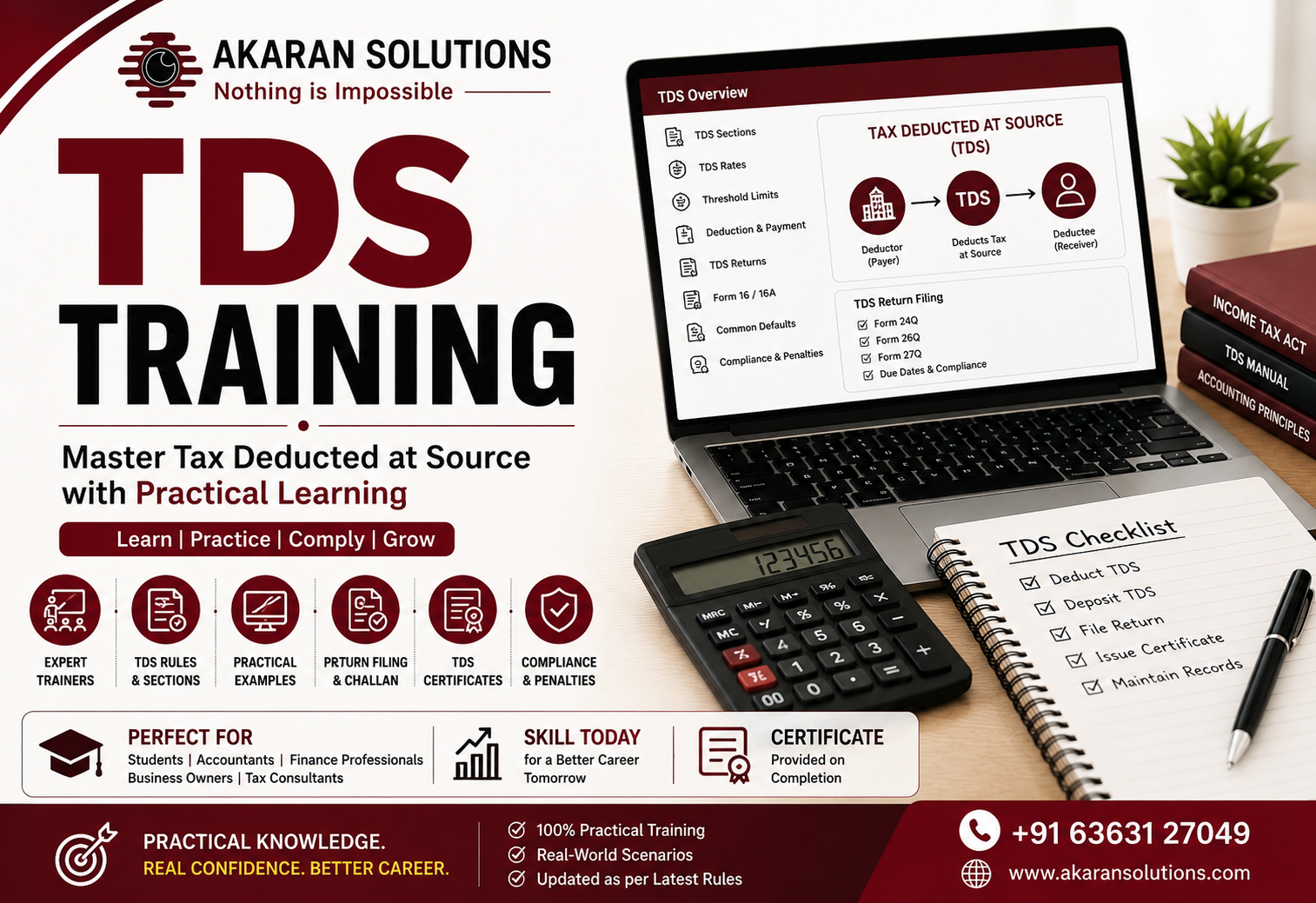
TDS Training is a professional course designed to provide comprehensive knowledge of Tax Deducted at Source. It combines theoretical concepts with practical learning to help individuals manage TDS-related activities efficiently.
The training typically covers:
- TDS provisions
- Applicable sections
- Deduction rates
- Challan payment
- Return filing
- TDS certificates
- Corrections
- Compliance requirements
- Practical software usage
The objective is to prepare participants for real-world taxation scenarios.
Who Should Join TDS Training?
TDS Training is suitable for individuals from various professional backgrounds.
Ideal participants include:
- Accountants
- Finance executives
- Tax consultants
- Chartered Accountancy students
- Company secretaries
- Business owners
- HR professionals
- Payroll executives
- Commerce graduates
- MBA Finance students
- Entrepreneurs
- Freelancers managing business accounts
Even beginners with no prior taxation knowledge can benefit from a well-structured training program.
Topics Covered in a Professional TDS Training Program
A comprehensive TDS Training course generally includes the following modules.
1. Introduction to Income Tax
Participants learn:
- Basics of Income Tax
- Residential status
- Types of income
- PAN
- TAN
- Tax structure in India
2. Understanding TDS Provisions
Topics include:
- Meaning of TDS
- Objectives
- Applicability
- Deductor
- Deductee
- Threshold limits
- Due dates
3. TDS Sections
Important sections covered include:
- Section 192 – Salary
- Section 194A – Interest
- Section 194C – Contractors
- Section 194H – Commission
- Section 194I – Rent
- Section 194J – Professional Fees
- Section 194Q – Purchase of Goods
- Section 194R – Benefits or Perquisites
- Section 194S – Virtual Digital Assets
Each section is explained with practical examples.
4. TDS Rates
Participants learn:
- Applicable tax rates
- PAN vs Non-PAN cases
- Surcharge
- Health and Education Cess
- Threshold limits
- Exemptions
5. TDS Payment Process
The course explains:
- Challan ITNS 281
- Online payment
- Due dates
- Interest calculations
- Late payment consequences
6. TDS Return Filing
Hands-on training covers:
- Form 24Q
- Form 26Q
- Form 27Q
- Form 27EQ
- Quarterly filing
- Validation
- FVU files
- Upload process
7. TDS Certificates
Participants learn about:
- Form 16
- Form 16A
- Download procedure
- Issuance timelines
- Digital signatures
8. TRACES Portal
Practical sessions include:
- Registration
- Login
- Downloading certificates
- Correction statements
- Justification reports
9. TDS Defaults and Penalties
Common mistakes include:
- Late deduction
- Late payment
- Incorrect PAN
- Delay in return filing
- Short deduction
- Non-deduction
The course explains how to identify and rectify these issues.
10. Practical Case Studies
Real business scenarios help learners understand:
- Vendor payments
- Salary processing
- Rent deductions
- Professional services
- Contractor bills
- Interest payments
Practical exposure improves confidence in handling day-to-day taxation tasks.
Benefits of TDS Training
Professional TDS Training offers numerous advantages.
Career Growth
TDS knowledge is highly valued across industries, increasing employability in finance, taxation, and accounting roles.
Better Compliance
Training helps businesses comply with tax regulations, reducing legal risks and penalties.
Practical Skills
Learners gain hands-on experience with government portals, challans, returns, and certificates.
Improved Accuracy
Understanding TDS provisions minimizes errors in deductions and filings.
Higher Confidence
Professionals can independently manage TDS responsibilities and advise clients effectively.
Career Opportunities After TDS Training
Completing TDS Training opens doors to several career paths.
Potential roles include:
- Tax Executive
- Accounts Executive
- Payroll Specialist
- Finance Officer
- GST & TDS Consultant
- Income Tax Consultant
- Audit Assistant
- Compliance Executive
- Tax Analyst
- Accounts Manager
Knowledge of TDS is also beneficial for entrepreneurs managing their own businesses.
Skills You Gain Through TDS Training
By the end of the course, participants can:
- Deduct TDS correctly
- Calculate tax accurately
- Prepare challans
- File quarterly returns
- Generate Form 16 and Form 16A
- Handle notices
- Rectify TDS defaults
- Maintain statutory compliance
- Use TRACES efficiently
- Interpret Income Tax provisions
Common Challenges Without Proper TDS Knowledge
Many organizations face issues such as:
- Incorrect tax deductions
- Missed due dates
- Late filing fees
- Interest liabilities
- Employee grievances
- Vendor disputes
- Tax notices
- Compliance failures
Structured training helps prevent these challenges.
Why Businesses Need Employees Trained in TDS
Organizations increasingly seek professionals who understand taxation because accurate compliance directly impacts business operations.
Trained employees help businesses:
- Reduce penalties
- Improve financial reporting
- Ensure timely compliance
- Maintain proper documentation
- Build trust with vendors and employees
- Prepare for audits confidently
Investing in TDS Training enhances operational efficiency and supports long-term growth.
Tips for Choosing the Right TDS Training Program
When selecting a training course, look for:
- Updated curriculum
- Practical assignments
- Experienced trainers
- Real-time case studies
- Hands-on software training
- Support for government portals
- Certification
- Placement assistance (if available)
- Flexible learning options
- Post-training support
A well-designed program combines theory with practical application to prepare learners for real-world responsibilities.
Frequently Asked Questions (FAQs)
1. What is TDS Training?
TDS Training is a professional program that teaches the rules, procedures, and practical aspects of Tax Deducted at Source, including deduction, payment, return filing, and compliance.
2. Who can join a TDS Training course?
Students, accountants, finance professionals, HR executives, business owners, tax consultants, and anyone interested in taxation can enroll.
3. Is prior taxation knowledge required?
No. Most beginner-level TDS Training programs start with the fundamentals and gradually progress to advanced topics.
4. Will I learn TDS return filing?
Yes. A quality training program includes hands-on practice in preparing and filing TDS returns using the relevant forms and government portals.
5. How does TDS Training help my career?
It enhances your accounting and taxation skills, making you eligible for roles such as Tax Executive, Accounts Executive, Payroll Specialist, Compliance Officer, and Tax Consultant.
6. Is TDS Training useful for business owners?
Absolutely. It helps business owners understand their statutory obligations, avoid penalties, and manage tax compliance efficiently.
7. Can TDS Training help in handling tax notices?
Yes. By understanding common defaults and correction procedures, learners are better equipped to respond to notices and maintain compliance.
Tax compliance has become an essential part of every business, regardless of its size or industry. Understanding the principles and practical applications of Tax Deducted at Source is no longer limited to tax professionals—it is a valuable skill for accountants, HR teams, entrepreneurs, finance executives, and students alike.
A well-structured TDS Training program equips learners with practical knowledge of TDS provisions, deduction rules, return filing, challan payments, certificates, and compliance requirements. Beyond helping individuals avoid costly mistakes and penalties, it also enhances career prospects in accounting, finance, taxation, and compliance.
Whether you are starting your career, looking to upskill, or aiming to strengthen your organization’s compliance framework, investing in professional TDS Training is a smart decision. The right knowledge not only ensures accurate tax management but also builds confidence to handle real-world financial responsibilities with ease.
