


The Indian restaurant industry has experienced remarkable growth over the last decade, driven by changing consumer preferences, online food delivery platforms, cloud kitchens, and an increasing demand for dining experiences. While running a successful restaurant requires exceptional food and customer service, staying compliant with taxation laws is equally important. One of the most significant tax obligations for restaurant owners is understanding GST on restaurant services.
Goods and Services Tax (GST) has simplified indirect taxation by replacing multiple taxes with a unified system. However, restaurant businesses often face confusion regarding GST rates, registration requirements, billing procedures, input tax credit (ITC), and return filing. Incorrect compliance may result in penalties, notices, and financial losses.
Whether you own a fine-dining restaurant, café, food truck, cloud kitchen, bakery, or takeaway outlet, understanding GST regulations is essential for smooth business operations.
At Akaran Solutions, we help restaurant businesses manage GST registration, return filing, tax compliance, and advisory services so that owners can focus on delivering excellent dining experiences while remaining fully compliant.
Understanding GST on Restaurant Services
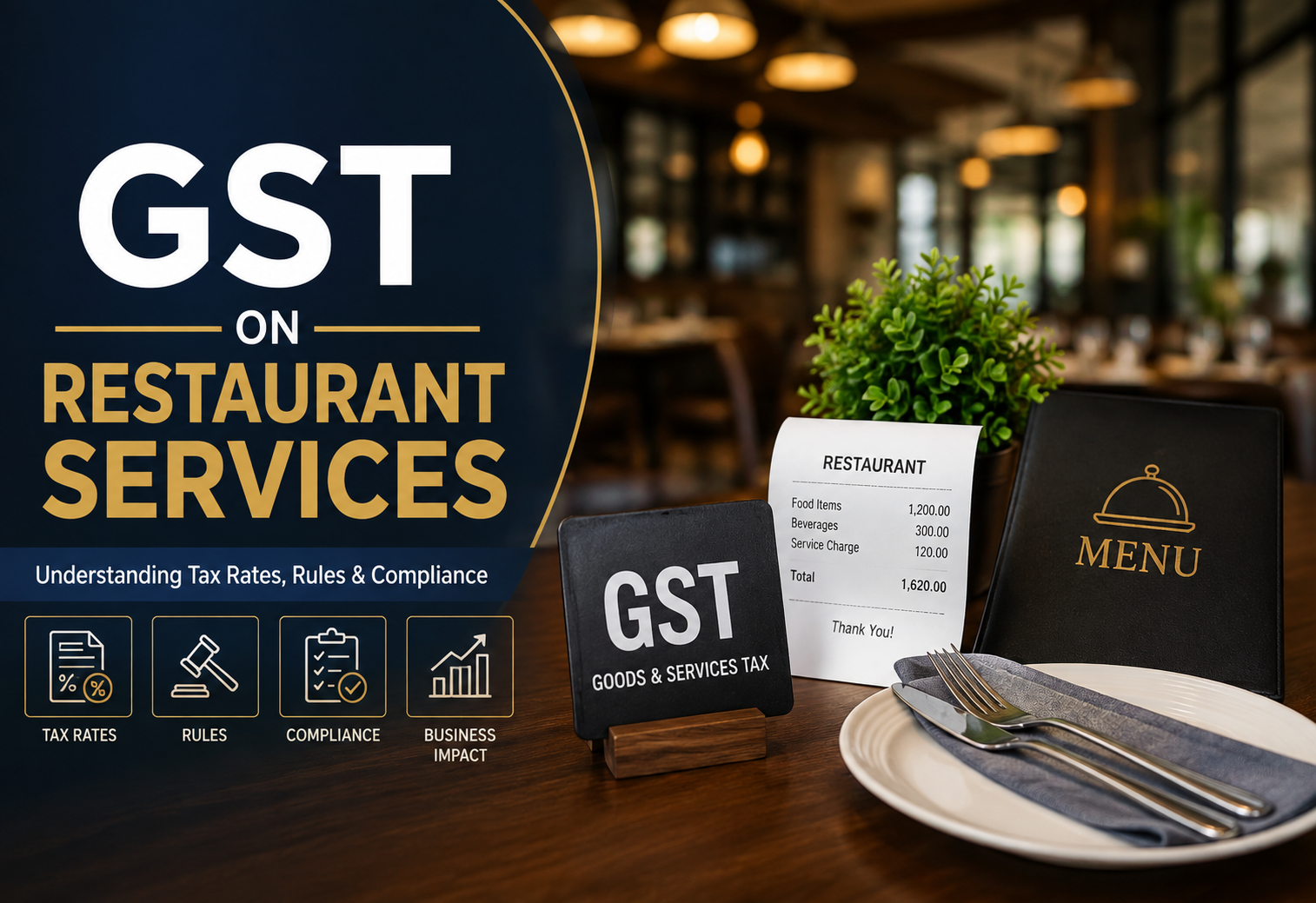
GST on restaurant services refers to the tax levied on food and beverage services provided by restaurants, cafés, eateries, hotels, and similar establishments. The applicable GST rate depends on the nature of the business and the type of restaurant.
Restaurant owners must charge GST correctly, issue GST-compliant invoices, maintain proper accounting records, and file GST returns within the prescribed timelines.
Failure to comply with GST regulations can attract interest, penalties, and departmental notices.
Why GST Compliance Matters for Restaurants
Proper GST compliance offers several benefits, including:
- Legal compliance with Indian tax regulations
- Improved business credibility
- Smooth tax assessments
- Accurate financial reporting
- Easier expansion opportunities
- Better vendor relationships
- Reduced risk of penalties
- Efficient business operations
Professional GST management also helps restaurant owners avoid costly mistakes that may affect profitability.
Who Needs GST Registration?
Restaurant businesses generally require GST registration if they meet the prescribed turnover limits or fall under mandatory registration categories.
Businesses requiring GST registration include:
- Restaurants
- Cafés
- Hotels serving food
- Fast-food outlets
- Food courts
- Cloud kitchens
- Caterers
- Franchise restaurants
- Multi-location food businesses
Voluntary registration may also benefit growing businesses by enhancing credibility and simplifying commercial transactions.
GST Rates Applicable to Restaurant Services
The GST applicable to restaurant services varies based on the category of restaurant and the nature of services provided.
Some factors affecting GST rates include:
- Standalone restaurants
- Restaurants inside hotels
- Outdoor catering services
- Takeaway services
- Food delivery
- Cloud kitchens
Restaurant owners should regularly review applicable GST provisions to ensure correct tax collection.
GST Registration Process
Obtaining GST registration involves several important steps.
Step 1: Collect Business Documents
Required documents generally include:
- PAN Card
- Aadhaar Card
- Business registration documents
- Address proof
- Bank account details
- Mobile number
- Email ID
- Passport-size photograph
Step 2: Apply Online
Applications are submitted through the GST portal with the required information and supporting documents.
Step 3: Verification
Authorities verify the submitted details.
Step 4: GSTIN Allotment
Upon successful verification, the business receives a GST Identification Number (GSTIN).
Importance of GST-Compliant Invoicing
Restaurants must issue invoices containing mandatory GST information.
A proper GST invoice generally includes:
- Restaurant name
- GSTIN
- Invoice number
- Invoice date
- Customer details (where applicable)
- Description of food items
- Taxable value
- Applicable GST
- Total invoice amount
Proper invoicing helps maintain transparency and simplifies return filing.
Maintaining Proper Books of Accounts
Restaurant businesses should maintain records such as:
- Daily sales
- Purchase invoices
- Vendor bills
- GST invoices
- Credit notes
- Debit notes
- Expense records
- Bank statements
- Inventory details
Well-maintained books make audits and GST filings significantly easier.
GST Return Filing for Restaurants
GST-registered restaurants are required to file returns periodically.
Timely filing helps businesses:
- Avoid penalties
- Prevent late fees
- Maintain compliance status
- Improve GST ratings
- Reduce notice risks
Professional filing ensures accurate reporting and reconciliation.
Common GST Challenges Faced by Restaurant Owners
Many restaurant owners struggle with:
Incorrect GST Classification
Improper classification may result in incorrect tax payments.
Invoice Errors
Missing GST details can create compliance issues.
Late Return Filing
Delayed filings attract additional costs.
Record Maintenance
Poor bookkeeping often results in mismatched returns.
Vendor Reconciliation
Mismatch between purchase records and GST returns affects compliance.
Professional assistance helps overcome these challenges efficiently.
GST Compliance for Cloud Kitchens
Cloud kitchens have become increasingly popular.
GST compliance for cloud kitchens includes:
- GST registration
- Proper invoicing
- Platform reconciliation
- Vendor management
- Monthly return filing
- Accounting support
Cloud kitchen operators should ensure proper documentation for every transaction.
GST on Online Food Delivery
Restaurants receiving orders through food delivery platforms should maintain accurate records of:
- Online sales
- Platform commissions
- Tax deductions
- Settlement reports
- Customer invoices
Regular reconciliation prevents discrepancies during return filing.
Benefits of Professional GST Services
Hiring GST professionals provides several advantages:
- Accurate GST registration
- Error-free filing
- Timely compliance
- Professional advisory
- Tax planning
- Notice handling
- Reduced compliance burden
- Better financial management
Restaurant owners save valuable time while ensuring complete compliance.
How Akaran Solutions Helps Restaurant Businesses
Akaran Solutions offers comprehensive GST services designed specifically for restaurants.
Our services include:
- GST Registration
- GST Return Filing
- GST Amendments
- Invoice Review
- GST Advisory
- Annual Compliance
- Notice Management
- Tax Consultation
- Business Registration
- Accounting Support
We ensure every compliance requirement is completed accurately and on time.
Common Mistakes Restaurants Should Avoid
Many businesses unknowingly make mistakes that can lead to penalties.
Avoid:
- Delayed GST registration
- Incorrect invoice generation
- Late return filing
- Poor bookkeeping
- Ignoring GST notices
- Incorrect tax calculations
- Missing reconciliation
- Improper documentation
Working with experienced professionals significantly reduces compliance risks.
Tips for Better GST Management
Restaurant owners can improve GST compliance by:
- Maintaining digital records
- Reconciling sales regularly
- Filing returns before due dates
- Verifying vendor invoices
- Conducting periodic audits
- Using accounting software
- Seeking professional advice
Consistent compliance reduces long-term tax issues.
Frequently Asked Questions
Is GST registration mandatory for every restaurant?
GST registration depends on applicable legal provisions, turnover thresholds, and the nature of business activities.
Can cloud kitchens register under GST?
Yes. Cloud kitchens are required to comply with GST regulations wherever applicable.
Why should restaurants file GST returns on time?
Timely filing helps avoid penalties, interest, and compliance notices.
Can professionals help with GST compliance?
Yes. Professional GST consultants ensure accurate registration, filing, documentation, reconciliation, and compliance management.
What records should restaurants maintain?
Restaurants should maintain invoices, purchase records, sales reports, bank statements, expense records, and GST returns.
Why Choose Akaran Solutions?
Businesses trust Akaran Solutions because we provide:
- Experienced GST professionals
- Accurate compliance support
- Timely filing
- Affordable pricing
- Personalized consultation
- End-to-end GST solutions
- Business-focused approach
- Reliable customer support
Whether you operate a single restaurant or a chain of outlets, our experts simplify GST compliance and help you stay focused on growing your business.
Understanding GST on restaurant services is essential for every restaurant owner in India. Proper GST registration, accurate invoicing, timely return filing, and organized financial records ensure hassle-free compliance and help businesses avoid unnecessary penalties.
As GST regulations continue to evolve, professional guidance becomes increasingly valuable. By partnering with Akaran Solutions, restaurant owners receive expert support for GST registration, return filing, advisory services, and complete tax compliance.
If you’re looking for reliable GST professionals to manage your restaurant’s compliance requirements, Akaran Solutions is your trusted partner. Our team ensures accurate filings, timely compliance, and expert assistance so you can focus on serving your customers while we take care of your GST obligations.
